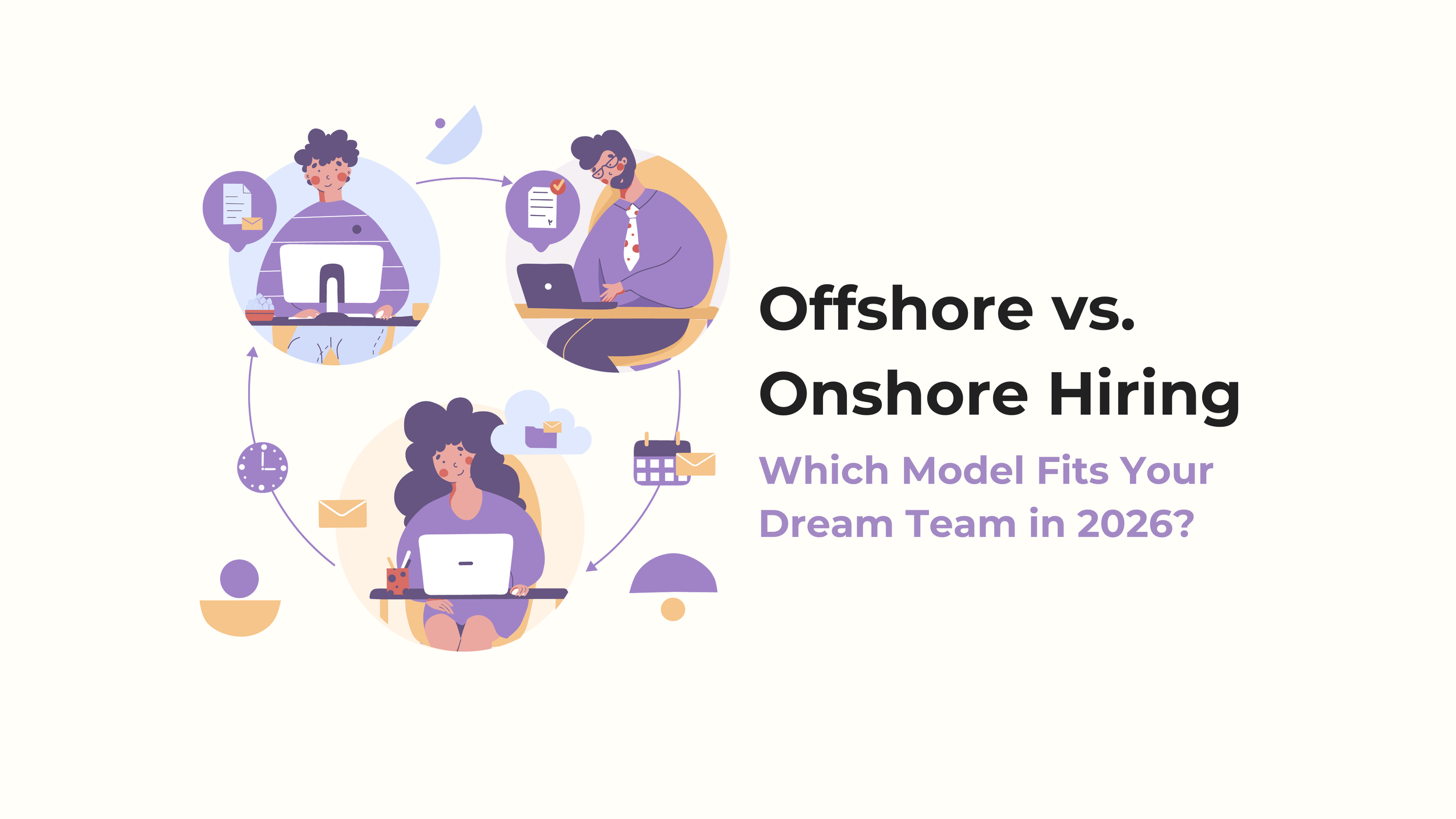
Offshore vs. Onshore Hiring: Which Model Fits Your Dream Team in 2026?
Every team leader dreams of building a high-performing team. But in 2026, the path to that “dream team” looks different from what it did just a few years ago.
With rising talent shortages, increased cost pressures, and new opportunities in global markets, leaders are asking: Should we hire offshore, stay onshore, or design a hybrid model?
To help you, we created a simple guide to offshore, onshore, and hybrid recruitment:
Offshore Hiring: Your global advantage
Offshore hiring is when organizations recruit talent from outside their home country—often in regions known for skilled professionals at competitive costs.
It works best when…
You need to scale fast with specialized roles.
You want cost-efficiency without compromising quality.
You operate in industries that benefit from round-the-clock productivity (IT, customer service, project execution).
Watch out for:
Communication and cultural gaps can occur if not managed well.
Compliance risks that require expert handling.
Onshore Hiring: Your local strength
Onshore hiring refers to recruitment within your home country, ensuring alignment with local market, culture, and compliance frameworks.
It works best when…
Roles that require deep local knowledge (e.g., sales, client-facing, or regulated positions).
Company culture and collaboration are top priorities.
Compliance and labor laws are complex and high-risk.
Watch out for:
Higher costs and competition for talent.
Smaller local talent pools, especially in niche areas.
Hybrid Hiring: The best of both worlds
Hybrid hiring is a blended approach—combining onshore hires for leadership and core functions with offshore hires for scalability, efficiency, and specialized skills.
It works best when…
Companies seeking balance between cost savings and quality.
Organizations expanding into new global markets.
Teams that want flexibility to scale without losing cultural cohesion.
Watch out for:
Requires thoughtful team design and integration strategies.
Needs clear systems for communication, accountability, and performance tracking.
Choosing the Right Model for Your Dream Team
So, which model fits your team in 2026?
If you need agility and global reach → consider offshore.
If you need local expertise and cultural alignment → go onshore.
If you want the advantages of both → hybrid may be your ideal solution.
The key isn’t choosing one model over another; it’s designing the right mix for your unique business goals.
Recruit your dream team with Elite Talent Recruit!
Since 2019, Elite Talent Recruit has been a trusted full-cycle recruiter for both Philippine-based and non-Philippine-based roles in industries like IT, health, beauty, BPO, and more across various levels of our clients' organization, from entry level to leadership roles.
It’s simple, we go beyond “filling vacancies.” We act as your consultant and partner, helping you:
Reduce hiring costs and time-to-fill.
Implement hiring frameworks that integrate culture, compliance, and scalability.
Find the right talent that fits your culture to reduce attrition.
Your dream team isn’t defined by location. It’s defined by the right people, skills, and strategy, and that’s what we deliver.
If you’re weighing your options, let’s talk.
We’ll help you design a recruitment strategy that balances cost, culture, and capability—so you can stay ahead in 2026 and beyond.